How to Measure a Hardcover Book Spine — Formula, Paper Calipers & Free Spine Calculator
The exact way to calculate spine width for a case-bound hardcover: pages ÷ 2 × paper caliper + two boards + hinge allowance. Includes PPI tables for common text stocks, a free interactive spine calculator, and how to set up the cover PDF so the title sits centred on the spine.
Why the spine is the one measurement you cannot eyeball
Every other dimension of a hardcover comes from the trim size you chose. The spine is different: it is a result — of how many pages you have, how thick each sheet is, how thick the boards are, and how the case is hinged. Get it 1/16" wrong and the title drifts onto the front cover, the cover wrap creases at the hinge, or the dust jacket shows a white sliver at the fold. This guide gives you the formula pre-press uses, the paper thickness tables, and a calculator that does the arithmetic for you.
The formula
- Text block thickness = (page count ÷ 2) × paper caliper. A 'page' is one side; a 'leaf' or sheet has two pages, so 240 pages = 120 leaves.
- Finished hardcover spine = text block + 2 × board thickness. Standard binder's board is 2.5 mm (0.098"); heavy boards are 3 mm (0.118").
- Cover-artwork spine (the width you set in the PDF) = finished spine + hinge allowance, typically 1/16" (0.0625") total, because the cover material wraps around the boards and into the joint.
- Perfect-bound softcover spine = text block + 2 × cover caliper (about 0.012" each for 12–14 pt cover). No boards, no hinge.
Example: a 240-page novel on 60# uncoated text (0.0045" caliper) → 120 × 0.0045 = 0.540" text block. Add two 2.5 mm boards (0.196") = 0.736" finished spine. Add 1/16" hinge allowance = 0.799" — set the spine panel in your cover file to 0.80" (≈ 20.3 mm).
Paper caliper and PPI — the numbers that matter
Paper mills publish thickness two ways: caliper (inches per sheet) and PPI (pages per inch — remember it counts pages, so divide by 2 for sheets). Typical values:
- 50# uncoated text (75 gsm): 0.0039" · 512 PPI
- 60# uncoated text (90 gsm): 0.0045" · 444 PPI — the standard novel and manual stock
- 70# uncoated text (105 gsm): 0.0055" · 364 PPI
- 80# gloss text (120 gsm): 0.0034" · 588 PPI — coated papers are denser and thinner
- 100# gloss text (150 gsm): 0.0045" · 444 PPI
- 80# matte/silk text: 0.0043" · 465 PPI · 100# matte/silk: 0.0055" · 364 PPI
- 55# cream book stock: 0.0049" · 410 PPI — bulkier, warmer, used for fiction
Coated and uncoated sheets of the same basis weight differ by up to 40% in thickness, which is why 'my last book was 200 pages and the spine was 0.6 inches' is not a safe guide when you change paper. When in doubt, ask us for the caliper of the exact stock we will run.
Measuring an existing book
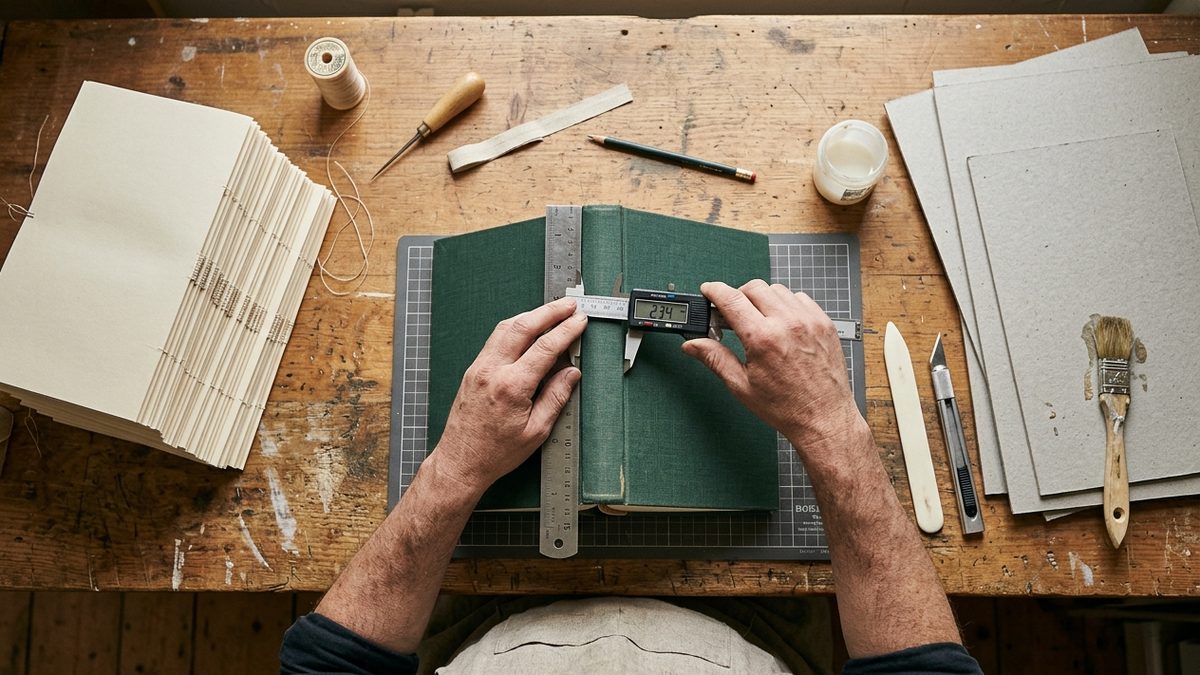
- Close the book and stand it on its tail. Measure across the spine from board edge to board edge with a steel rule or digital calipers — this is the finished spine.
- Do not measure across the rounded back on a rounded-and-backed book; measure the boards at the hinge.
- For a dust jacket, measure the finished spine, then add 1/16" and let the artwork bleed a further 1/8" onto the front and back panels so registration is forgiving.
- Count leaves, not pages, if you are reverse-engineering paper caliper: spine − (2 × board) ÷ leaves = caliper per sheet.
Setting up the cover file
- Build the cover as one spread: back cover + spine + front cover, plus 0.75" turn-in on all four outer edges for a printed paper case (0.125" bleed only for a dust jacket).
- Centre spine type on the calculated spine width and keep it at least 1/16" from each hinge line; spines under 3/8" should carry the title only, no author line.
- Avoid hard colour changes exactly on the hinge — a 1/32" shift makes them visible. Run background colour across the joint or place the change 1/8" onto the cover panel.
- Export a PDF/X-4 with the spine width noted in the file name (e.g. 'Cover_spine-0.80in.pdf'). We re-measure the actual text block on the first bound sample and confirm the spine on your proof before the run.
Page-count limits for case binding
- Minimum: about 48 pages on uncoated text (a 3/16" block) for a square-back case; thinner blocks are better as saddle-stitched or perfect-bound softcovers.
- Sweet spot: 96 – 600 pages. Above roughly 2" of block, we section-sew and round-and-back for durability.
- Maximum practical: ~1,000 pages on 50# text. Beyond that, split into volumes.
- Hard-Cover Case-Bound BooksPrinted-paper case or cloth with dust jacket
- Hardcover Book Printing GuideMaterials, binding styles and timeline
- Hardcover Cover Design GuideCase, jacket and end-paper artwork
- Saddle Stitch vs Smyth vs PUR vs PerfectWhich binding for which page count
Frequently asked questions
- How do I calculate the spine width of a hardcover book?
- Divide the page count by two to get leaves, multiply by the paper caliper for the text block, add two board thicknesses (usually 2 × 0.098" for 2.5 mm boards), then add about 1/16" hinge allowance for the cover artwork. The calculator above does this automatically.
- What is PPI in book printing?
- Pages per inch — how many pages (not sheets) stack to one inch of thickness. Divide 2 by the PPI to get the caliper per sheet; 444 PPI equals 0.0045" per sheet.
- Is the spine width the same for a dust jacket and a printed case?
- The finished spine is the same, but the jacket needs the spine plus about 1/16" and generous bleed onto the panels, while a printed paper case needs 0.75" turn-ins on every outer edge.
- How thin can a hardcover book be?
- About 48 pages on uncoated text — a 3/16" text block — is the practical minimum for a square-back case with a readable spine title.
- Will you confirm my spine before printing?
- Yes. We measure the actual bound text block from your chosen stock, adjust your cover file if needed, and confirm the final spine on your PDF proof before the run.
- Are your hardcover books made in the USA?
- Yes — printed and case-bound in our Houston, Texas facility and shipped nationwide.
Kolt Printing ships from Houston, TX every business day.
Live pricing on every product. Free die templates. Same-day shipping cut-off at 11 AM Central. Trade pricing for agencies and print brokers.