Luxury Presentation Folders — Hot Foil Stamping and White Ink on Colorplan Ebony
How to produce a truly high-end presentation folder: GF Smith Colorplan Ebony 540 gsm, hot-foil stamped logo in copper, gold or silver, opaque white ink for text, blind deboss and edge details. Artwork rules, foil vs white ink, pocket and capacity options, and how to request a custom quote.
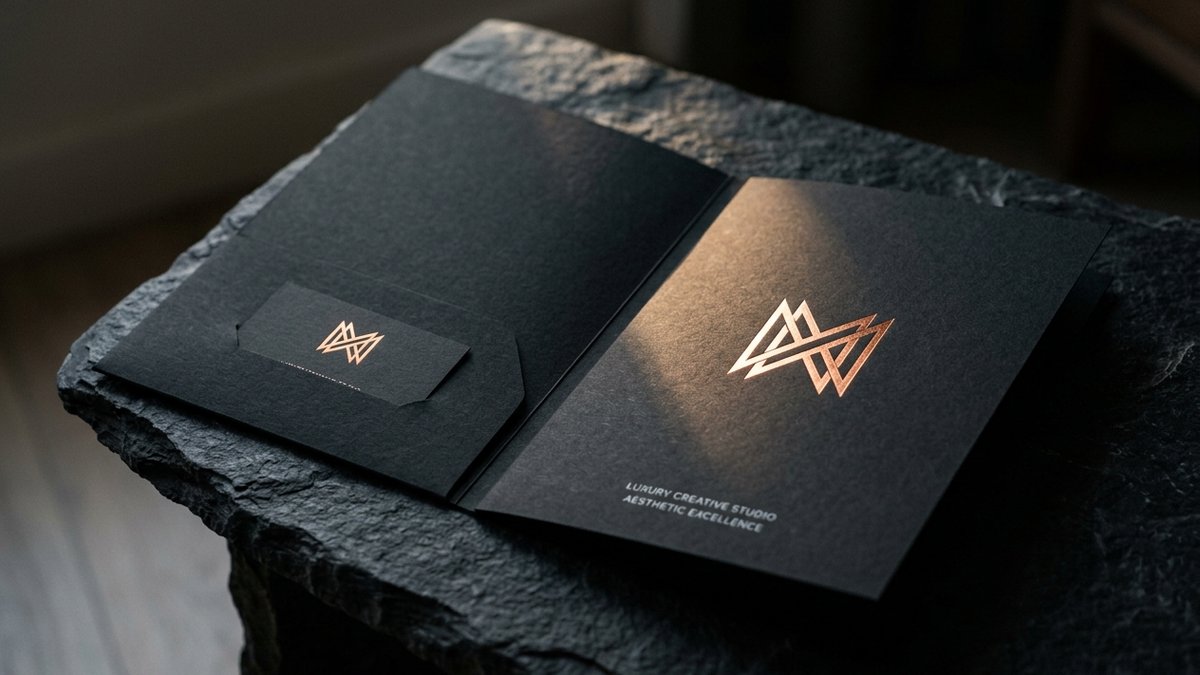
The folder that gets kept
A presentation folder is the first physical thing a client holds from you — the proposal, the closing documents, the onboarding pack live inside it. Most folders are 14 pt gloss with a four-colour logo and are in the recycling by Friday. The ones that stay on the desk are matte black, heavy in the hand, with a mark that catches the light. That combination — GF Smith Colorplan Ebony, hot-foil stamping and opaque white ink — is what we build our luxury folders from, in Houston, shipped nationwide.
Why Colorplan Ebony
- It is black all the way through. Colorplan is dyed in the pulp, so folds, edges, business-card slits and pocket cuts show the same deep black — no white core flashing at the crease like a printed-black folder.
- Uncoated, soft-touch surface with a fine tooth. It feels like fabric rather than plastic, it does not fingerprint the way soft-touch lamination does, and it takes foil and ink beautifully.
- Heavy. We build folders on 350 gsm for standard use and 540 gsm for the flagship pieces — the 540 stands up on its own and closes with a satisfying weight.
- Consistent. Ebony is a stocked line in the Colorplan range, so a re-order in two years matches the first run exactly.
Ebony is the default, but the same construction works on Colorplan Racing Green, Imperial Blue, Claret or Dark Grey when a brand palette calls for it. All 55 colours are on our Resources page.
Hot foil stamping: the mark
Hot foil is a heated brass or magnesium die pressing a metallic film onto the sheet. Unlike metallic ink, it is a true reflective surface — mirror-bright or brushed, in gold, copper, rose gold, silver, gunmetal, or a pigment foil such as matte white or a brand colour. On a black uncoated sheet it is the only way to get a genuinely metallic result.
- Best for: the logo or monogram, a firm name, a single rule or border detail. One or two foil colours per side; the die is a one-time tooling cost and is kept for re-orders.
- Minimum line weight around 0.35 pt for positive foil and 0.5 pt for fine reversed detail; small serif type below 6 pt can fill in.
- Foil can be combined with an emboss (raised) or deboss (pressed) in the same hit for a sculpted logo — our most requested luxury finish.
- Large solid foil areas over about 4 square inches are possible on Colorplan but show every dust speck; keep foil to marks and type, and let the paper be the field.
White ink: the words
Foil is for the mark; white ink is for everything else. Address lines, taglines, a sentence of positioning, the pocket's contact block — anything with more than a few words reads more cleanly in opaque white than in foil, and it costs far less because there is no die. We print white as a spot colour in one or two hits for full opacity on Ebony.
- White ink on uncoated black is soft and slightly matte — it looks like chalk on slate rather than a printed sticker, which is exactly the point.
- Minimum type size 7 pt; avoid hairline serifs and very light weights, which lose opacity. Medium and bold weights are crisp.
- White can be printed as a tint (60–80%) for a subtle grey-on-black secondary line while the primary text stays 100%.
- Photographs and gradients in white are not recommended on Ebony — reserve those for a printed insert sheet.
Foil vs white ink — quick guide
- Logo or monogram → hot foil (metallic) or blind deboss (no colour).
- Firm name in large type → foil for impact, white ink for restraint.
- Addresses, URLs, body copy → white ink.
- Second brand colour → pigment foil or a second spot ink (Pantone U).
- Texture without colour → blind emboss or deboss of a pattern or the logo at large scale.
Construction: pockets, capacity and slits
- Standard 9" × 12" two-pocket folder holds letter-size documents; 9.5" × 14.5" legal folders and 6" × 9" mini folders are also available.
- Pockets: two horizontal 4" pockets is the classic; a single right-hand pocket with a left-side business-card slit is the law-firm favourite; a vertical right pocket suits real-estate closing packs.
- Capacity: flat pockets hold about 20 sheets; add a 1/4" or 3/8" box-pocket or expansion spine for thick proposals, and a reinforced 1/2" capacity spine for closing documents.
- Business-card slits (four-corner or two diagonal) and a brochure slot are cut clean through Ebony with no white showing.
- Optional matching Colorplan Ebony insert sheets with white-ink headers, and a coordinating letterpress or foil business card to sit in the slit.
Artwork checklist
- Vector artwork (AI, INDD or PDF) with type outlined. Set up three layers or separate files: FOIL (one spot colour per foil), WHITE (spot colour named 'White'), EMBOSS/DEBOSS if used.
- Do not place any elements within 3/16" of a fold, slit or pocket glue flap. We supply a die-line template for the exact folder style.
- Foil and white should not overlap unless you want white under foil for a specific effect — tell us.
- Supply Pantone references for any coloured foil or second ink. Send us a photo of a folder you admire and we will spec it back to you.
Who orders these
- Law firms and wealth managers — closing and onboarding packs that are kept for years.
- Architects, developers and luxury real estate — property and proposal presentations.
- Hotels, private clubs and event planners — welcome folders and menus.
- Fashion, jewellery and cosmetics brands — press kits and wholesale line sheets.
Quantities, timing and price
Luxury folders are converted by hand: foil die, white-ink pass, die-cutting, folding and pocket gluing. Minimum run is 100 folders; pricing improves sharply at 250 and 500. Standard turnaround is 10–12 business days after proof approval, with the foil die kept on file so re-orders are faster and cheaper. Rush production is possible on many jobs — tell us the date.
- GF Smith Colorplan Paper GuideAll 55 colours, weights, duplexing and finishes
- Letterpress Printing Done RightOne Pantone colour on duplexed Colorplan
- Custom Presentation Folders — Sizes & PocketsStandard sizes, pocket options and card slots
Frequently asked questions
- Can you print white on a black folder?
- Yes. We print opaque white as a spot ink on Colorplan Ebony, in one or two hits for full coverage. It is the best way to reproduce text and small details on black stock; metallic marks are better as hot foil.
- What is the difference between hot foil and metallic ink?
- Hot foil is a real metallic film pressed onto the paper with a heated die, giving a mirror or brushed metal finish. Metallic ink is pigment and looks dull on uncoated black paper. For gold, copper or silver on Ebony, foil is the only option that truly shines.
- Which Colorplan weight should I choose for a folder?
- 350 gsm for a premium everyday folder; 540 gsm for a flagship piece that stands on its own. Both are dyed through, so folds and slits stay black.
- Do I pay for the foil die every time?
- No. The die is a one-time cost and we keep it on file, so re-orders skip the tooling charge.
- What is the minimum quantity and turnaround?
- 100 folders, 10–12 business days after proof approval. Rush production is available on request.
- Can I see the Ebony paper before ordering?
- Yes — view it with the full Colorplan palette on our Resources page, and we can post a physical swatch or a blank folder sample.
Kolt Printing ships from Houston, TX every business day.
Live pricing on every product. Free die templates. Same-day shipping cut-off at 11 AM Central. Trade pricing for agencies and print brokers.