10×10 Custom Event Tents — The Complete Buyer's Guide (Frame, Canopy, Walls & Artwork)
Why 10×10 is the standard event footprint, what a hex aluminum frame gets you, how dye-sublimated canopies hold colour, canopy-only vs. back wall vs. full walls, ballast for concrete, and how to design artwork that reads from across the fairground. Made in the USA, ships nationwide in 2 business days.
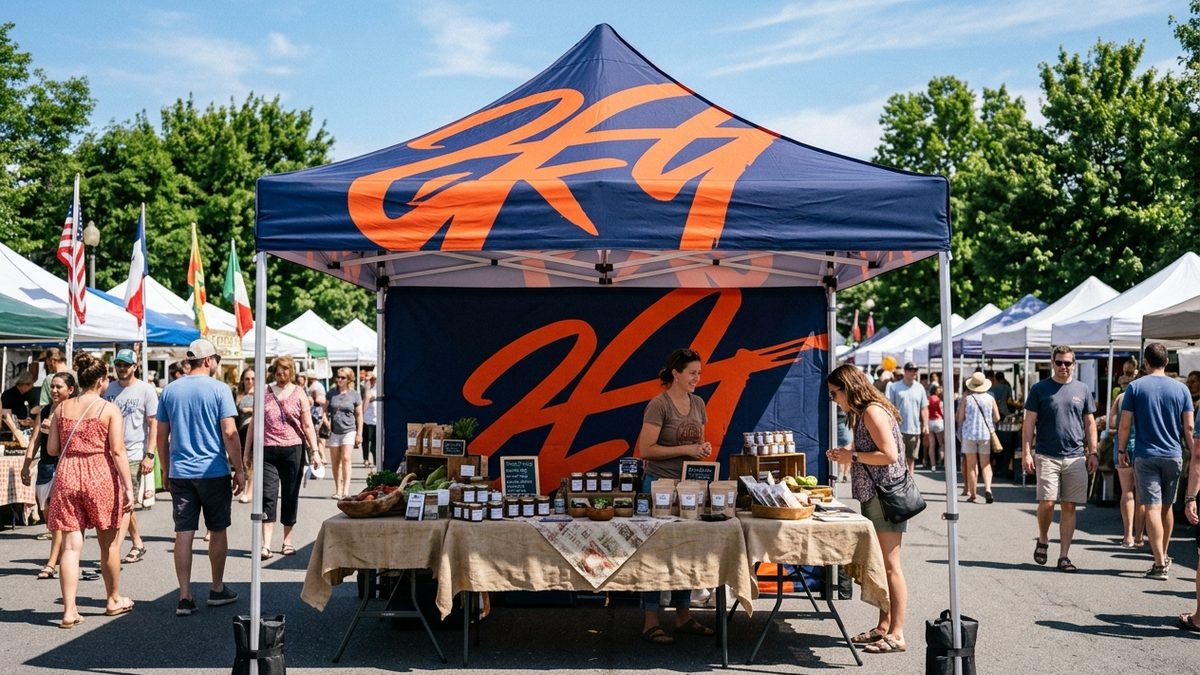
The most valuable 100 square feet at any event
Walk any farmers market, street fair, 5K finish line or outdoor trade show and count the tents. The ones you remember are the ones printed edge to edge — canopy, valance and back wall in the brand's colours. A blank white tent is shade. A custom 10×10 tent is a billboard you can see from three rows away, a backdrop for every photo taken at your booth, and a piece of kit you will use dozens of times a year for five years or more. Our 10' × 10' Custom Event Tent pairs a heavy-duty aluminum hex frame with a 6 oz dye-sublimated weatherproof canopy, optional printed walls, and ships in 2 business days from Houston, Texas.
Why 10×10 is the standard
Ten by ten feet is the footprint most event organisers allocate to a single vendor or exhibitor space — it is literally the grid the fairground is drawn on. It fits a 6-ft table, two people, product display and a back wall with room to move, but folds to a single carry bag that goes in the back of any SUV. Larger 10×15 and 10×20 tents exist, but they need two booth spaces and two people to set up; smaller 8×8 tents look under-sized next to neighbours. If you only buy one tent, buy a 10×10.
The frame is what you are really paying for
- Hex aluminum legs: six-sided profiles are dramatically stiffer than round or square tube of the same weight, resisting the racking that bends cheap steel frames in a gust.
- Aluminum, not steel: roughly half the weight for the same strength, no rust — important if the tent lives in a trailer or garage between events.
- Adjustable height: three leg settings (typically around 6'2", 6'8" and 7'2" at the valance) so you can drop the canopy in wind or raise it for a taller display.
- Thumb-release sliders and push-button legs: a two-person set-up in under 3 minutes, no tools.
- Set-up tip: extend the canopy fully before raising the legs, and raise diagonally opposite legs first so the frame stays square.
Dye-sublimated canopy — why it beats screen print and vinyl
Screen-printed tents lay ink on top of the fabric; it cracks along fold lines within a season. Vinyl heat-transfer peels at the edges. Dye-sublimation turns solid dye into gas and drives it into the polyester fibres, so the colour is part of the fabric — it cannot crack, peel or flake, and it folds a thousand times without damage. It also prints photographs, gradients and unlimited colours at no extra cost, so the whole 10×10 top plus four valances can be one continuous design.
- 6 oz weather-resistant polyester with a water-repellent coating — showers run off, and the fabric dries fast.
- UV-stable dyes rated for years of outdoor use without noticeable fade.
- CPAI-84 flame-retardant fabric, the standard most event organisers and fire marshals require.
- Machine-washable cold for muddy-field recovery; hang to dry.
Canopy only, back wall, or full walls?
- Canopy only: the printed top and four valances on the frame. Right for markets and fairs where you want an open, walk-up booth, and the most economical way to get branded.
- Full back wall: a printed 10-ft wide × ~7-ft tall panel that zips or Velcros to the rear legs. It blocks the view of the tent behind you, gives your booth a clean backdrop for photos and product shots, and roughly triples the printed area customers see. The most popular upgrade.
- Back wall + two full side walls: a three-sided room. Essential for wind, sun and privacy on exposed sites, and for booths that store stock, run registration, or want a defined interior. Side walls can be printed or left plain.
- Design tip: put the logo and one message on the back wall at eye level (4–6 ft from the ground); the canopy top is seen from a distance and above, so it carries the biggest, simplest brand mark.
Ballast: don't let the tent become a kite
Every event tent needs weight. On grass or dirt the included ground spikes and guy ropes do the job. On concrete, asphalt or indoors — where you cannot stake — you need base weights. We offer a steel X-cross base that bolts to each leg, and an X-cross base plus 22 lb water-fill ballast bag for a combined ~40 lb per leg without carrying sandbags. Most organisers require a minimum of 40 lb per leg for outdoor events; check your event's vendor pack.
Designing artwork that works at 50 feet
- One idea per surface. Canopy top: logo. Valances: brand name or URL, repeated on all four sides. Back wall: logo + one message + one call to action.
- Letter height rule: 1 inch of cap height per 10 feet of viewing distance. Valance text should be at least 6 inches tall.
- Bold, flat colour outperforms photography on the canopy; save photos for the back wall.
- Keep critical text 3 inches inside every seam, valance edge and peak — the fabric wraps the frame.
- Choose colours that survive shade: the underside of the canopy is in shadow, so the top and valances should be saturated, not pastel.
- Supply CMYK PDF, AI, EPS, TIFF or PSD at 150 DPI full size (or 600 DPI at quarter scale) on our tent template; a Kolt designer pre-flights every file and sends a proof before printing.
What's in the box
- Heavy-duty aluminum hex frame with adjustable legs.
- Full-colour dye-sublimated 10×10 canopy with four printed valances.
- Optional printed back wall and side walls (if selected).
- Ground spikes and guy ropes for soft ground.
- Standard carry bag; a wheeled premium bag is available as an upgrade for teams doing back-to-back events.
Where 10×10 tents pay for themselves
- Farmers markets, craft fairs and food festivals — weekly use, instant recognition.
- Outdoor trade shows, expos, dealer days and product demos.
- Sports: 5K and marathon finish lines, team tents, sponsor villages, tailgates.
- Real estate and home-builder open houses and community events.
- Schools, churches and non-profits — registration, fundraising, welcome tents.
- Breweries, wineries and beverage brands at tastings and festivals.
- Auto dealers, gyms, medical practices and service brands at community fairs.
Pricing, turnaround and shipping
The complete printed tent — frame, canopy and carry bag — starts at a flat price with walls and ballast priced as add-ons in the configurator, so you see your total live before you order. Standard production is 2 business days from artwork approval, with a 1-business-day rush available. Every tent is printed and finished in the USA in our Houston, Texas facility and ships nationwide via FedEx or UPS; ground delivery reaches most of the country in 1–3 business days. Ordering for a team or a franchise group? Request a quote for multi-tent pricing.
- Tension Fabric Banners GuideMatching backdrops for your booth
- Retractable Banner Artwork GuideAdd a roll-up banner beside the tent
- Trade Show Print ChecklistEverything else you need for the booth
- All Banners & DisplaysBrowse the large-format range
Frequently asked questions
- Is the 10×10 custom tent made in the USA?
- Yes. The canopy and walls are dye-sublimated, sewn and finished in our Houston, Texas facility — made in the USA — and every tent ships nationwide to all 50 states.
- Is the canopy waterproof?
- The 6 oz polyester has a water-repellent coating that sheds rain showers. Like all pop-up tents it is not designed for standing water — pitch it taut and lower the legs in heavy weather.
- How much wind can the tent take?
- With 40 lb of ballast per leg and the canopy lowered, hex-frame tents handle typical gusty event days. No pop-up tent is rated for sustained high winds; if organisers call a wind hold, drop the canopy or pack down.
- Can I buy a replacement canopy later?
- Yes. Frames outlast graphics, so when you rebrand or change your message you can order a new canopy or wall alone — contact us with your frame details.
- How long does set-up take?
- Two people, about 3 minutes: unfold the frame, pull to about 80% extension, attach the canopy corners, extend fully, then raise the legs diagonally.
- Can you print photographs on the tent?
- Yes — dye-sublimation prints full-colour photography and gradients. We recommend keeping photos on the back wall and using bold flat graphics on the canopy for distance legibility.
- What is the turnaround?
- Standard production is 2 business days from artwork approval; a 1-business-day rush is available. Ground shipping adds 1–3 business days nationwide.
- Do you offer wheeled carry bags?
- Yes — a premium wheeled bag is available as an upgrade for teams moving the tent frequently.
Kolt Printing ships from Houston, TX every business day.
Live pricing on every product. Free die templates. Same-day shipping cut-off at 11 AM Central. Trade pricing for agencies and print brokers.