Felt Roll Labels — Textured Paper Labels That Customers Can Feel
What makes felt-textured labels different from smooth paper, how Felt White, Felt Beige, Natural Kraft and Estate #9 compare, how to design for uncoated textured stock, and which products they sell best on. The complete guide to custom felt roll labels for craft beer, spirits, candles, soap and boutique beauty.
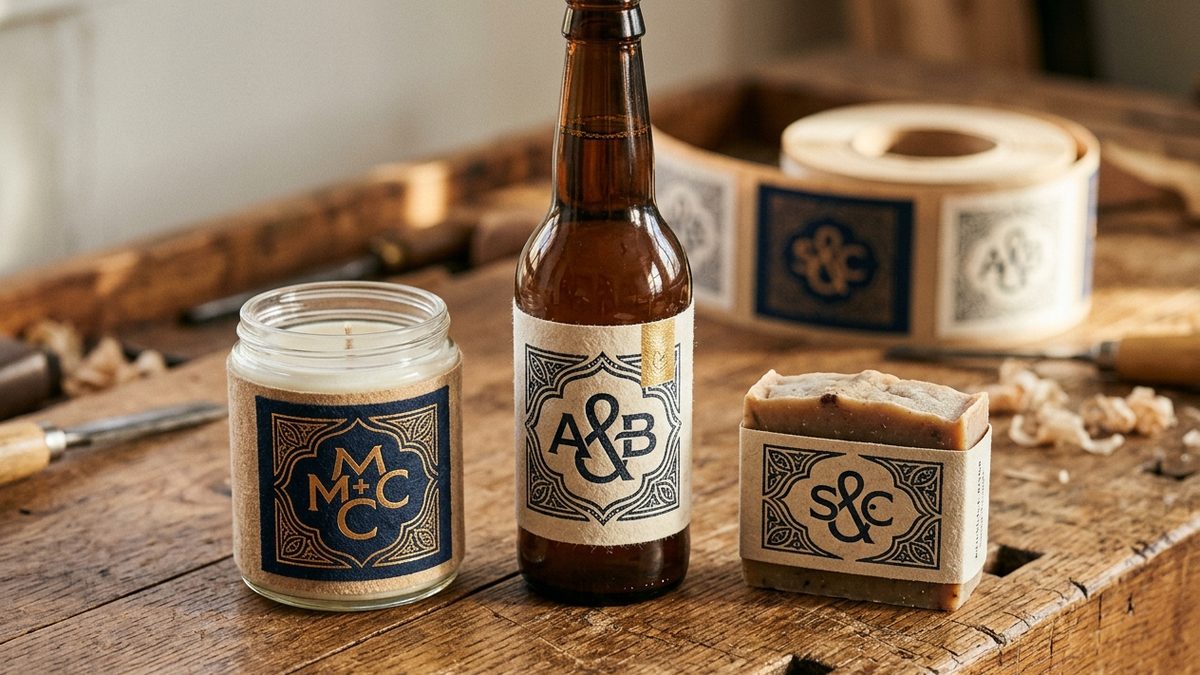
The label you notice with your fingers first
Most labels are judged by the eye. Felt labels are judged by the hand. The moment a customer picks up the bottle or jar, the soft woven texture of an uncoated felt stock tells them this was made carefully, in small batches, by people who care — before they have read a single word. That is why craft breweries, distilleries, candle makers, soap studios and boutique beauty brands specify felt: it makes the product feel expensive without making the label look loud. Our Felt Roll Labels are printed full-colour on natural-white or beige felt, natural kraft or classic Estate #9, and ship on rolls from Houston with a 250-label minimum.
What "felt" paper actually is
Felt finish is created on the paper machine when the wet sheet is pressed against a textured woollen felt blanket. The blanket leaves a soft, irregular, fabric-like pattern in the fibres — not embossed on afterwards, but formed into the paper itself. The result is an uncoated stock with genuine depth: light catches the high points and shadows sit in the low points, so even a single flat colour looks richer than it does on smooth paper. Because it is uncoated, ink soaks slightly into the fibres and colours dry with a warm, matte, letterpress-like character.
The four textured stocks compared
- Textured Felt White — the natural-white base. Brightest colour reproduction of the four, soft woven texture. The default for beauty, candles and any brand with a clean, modern palette.
- Textured Felt Beige — a warm cream tone. Photographs beautifully, flatters deep greens, burgundy, navy and black, and gives an instant heritage feel. Perfect for spirits, honey, olive oil and small-batch food.
- Natural Kraft — the unbleached brown craft-paper look. Rustic, honest, eco-coded. Colours print muted (the brown base shows through), so design with black, white ink or one bold accent. Coffee, granola, soap and farmers-market goods live here.
- Estate #9 — the classic wine-label stock: a fine laid texture with a subtle vertical grain, white base. The choice for wine, premium spirits, and anything that wants to look like it has been on the shelf for a hundred years.
All four are uncoated and indoor-rated. All four take the same permanent, aggressive or removable adhesives, and all four are priced on the same live configurator so you can compare finishes side by side before you commit.
Designing for textured, uncoated stock
Uncoated paper behaves differently from gloss labels, and the brands that get the most out of felt design with that in mind:
- Expect dot gain. Ink spreads slightly into the fibres, so colours print roughly 10–15% darker and softer than on coated stock. Lighten mid-tones and gradients a touch in the file.
- Favour deep, saturated colours over large areas of pale tint. Navy, forest green, oxblood, charcoal and black look extraordinary on felt; a large field of pastel can look washed-out.
- Let the paper show. The most effective felt labels leave 30–50% of the stock unprinted — the texture is the feature, and the natural-white or beige base becomes your background colour for free.
- Fine type holds well down to about 6 pt in a solid colour. Avoid reversed (white-out) type under 8 pt, since ink spread can close up the counters.
- Skip heavy solid coverage across the whole label. Flooding uncoated felt with ink hides the texture you paid for and can cause the label to curl slightly on tight-radius containers.
- Photographs work, but treat them like a letterpress print: increase contrast, avoid delicate highlights, and expect a softer, more editorial result than on gloss.
Foil, embossing and finishing
Felt is the classic partner for hot-foil stamping — gold or copper foil pressed into a textured, dark-printed felt label is one of the most recognisable premium cues in craft beverage. Because the stock is uncoated it is not laminated (lamination would flatten the texture), so foil, blind embossing and deboss are the finishes to reach for. Tell us what you have in mind in the production notes when you order, or request a quote for foil-stamped felt and we will spec the die and the foil colour with you.
Where felt labels sell best
- Craft beer, cider and mead — bottle fronts, can wraps for special releases, and neck labels.
- Whisky, gin, rum and small-batch spirits — Estate #9 or Felt Beige with a single foil hit.
- Wine — Estate #9 is the industry standard for a reason.
- Candles and home fragrance — Felt White or Kraft wrap-around jar labels and lid seals.
- Handmade soap, bath and body — Kraft or Felt Beige belly bands and box labels.
- Artisan food — honey, jam, hot sauce, chocolate, coffee, granola, olive oil.
- Boutique beauty and apothecary — dropper bottles, balm tins and gift boxes.
- Gifting, weddings and events — favour tags, wax-seal-style circles, thank-you stickers.
Adhesives and surfaces
- Permanent (standard): glass bottles, jars, tins, rigid and folding cartons, kraft boxes. Service range –4 °F to 158 °F.
- Aggressive: low-energy plastics, textured or recycled board, cold-room application lines.
- Removable: gift tags, seasonal promotions, sampling programmes, reusable packaging.
- Uncoated paper is not moisture-proof. Felt labels are rated for indoor use; for products that live in ice buckets, showers or fridges, choose White BOPP synthetic labels instead and keep felt for the outer box or gift tag.
Felt vs. smooth paper vs. synthetic — a quick decision guide
- Felt / Kraft / Estate #9 — tactile, artisan, indoor. Best for shelf products, gifting and premium dry goods.
- Semi-gloss or matte paper — smooth, bright, economical. Best for everyday retail and high-volume runs.
- White BOPP synthetic — waterproof, tear-proof, laminated. Best for wet, cold or handled products.
- Metallic gold or silver — shelf sparkle, foil-stamp look at print pricing. Best for spirits, beauty and confectionery.
Sizes, shapes, minimums and turnaround
Rectangles, squares, circles and ovals with square or rounded corners are standard, and custom die-cut shapes are available on request. Sizes run from small 1" seals to full wrap-around bottle and jar labels. The minimum order is 250 labels per design, and the unit price falls by nearly 50% between 250 and 2,000 pieces, so order for the season rather than the week. Standard production is 3–5 business days from proof approval; every file is pre-flighted by a Kolt designer and you receive a PDF proof within 24 hours. Labels ship on rolls wound to your applicator's core size and unwind direction, nationwide from our Houston, Texas facility — every felt label is made in the USA.
- Paper Roll LabelsSmooth semi-gloss, matte or high-gloss
- Gold Roll Labels GuideFoil-stamp look without the die
- White BOPP Synthetic Labels GuideFor wet, cold or handled products
- Custom Roll Label Sizing GuidePick the right dimensions for your container
Frequently asked questions
- Are these labels made in the USA?
- Yes. Every roll is printed, die-cut and finished in our Houston, Texas facility — made in the USA — and we ship nationwide to all 50 states with same-day dispatch on orders confirmed before 11 AM CT.
- What is the difference between felt labels and regular paper labels?
- Felt labels are printed on uncoated paper with a woven, fabric-like texture formed into the sheet at the mill. Standard paper labels are smooth and usually coated. Felt looks and feels artisan and premium; smooth paper looks clean and commercial.
- Can felt labels be printed in full colour?
- Yes — CMYK on all four textured stocks. Colours print slightly softer and darker than on coated paper, so we recommend deep, saturated palettes and leaving part of the stock unprinted.
- Are felt labels waterproof?
- No. Felt, kraft and Estate #9 are uncoated papers rated for indoor use. Light condensation is fine; prolonged wetting is not. For ice buckets, showers or refrigeration choose White BOPP synthetic labels.
- Can I add gold foil to a felt label?
- Absolutely — foil stamping is the classic finish for felt. Gold, copper, silver, rose gold and holographic foils are available; request a quote or note it in production notes when you order.
- Which textured stock is best for wine or spirits?
- Estate #9 is the traditional wine and premium spirits stock. Felt Beige is a warmer alternative for whisky, rum and craft gin; Natural Kraft suits rustic, farm-to-bottle brands.
- Do felt labels work with automatic label applicators?
- Yes. Tell us your core size, maximum roll diameter and unwind direction and we will wind the rolls to match your machine. Hand-applying? We default to a 3" core, outside wound.
- What is the minimum order and turnaround?
- 250 labels per design, with price breaks at 500, 750, 1,000 and 2,000. Standard production is 3–5 business days after you approve the PDF proof.
- How should I store felt labels?
- Keep rolls in the original bag at room temperature away from humidity. Uncoated paper absorbs moisture, which can affect adhesion and flatness if rolls are left open in a damp space.
Kolt Printing ships from Houston, TX every business day.
Live pricing on every product. Free die templates. Same-day shipping cut-off at 11 AM Central. Trade pricing for agencies and print brokers.