Gold Roll Labels — The Foil-Stamp Look Without the Foil-Stamp Bill
How metallic gold labels are made, Bright Gold vs. Dull Gold, why white-ink underprint matters, when to add lamination or a second foil, and how to design artwork that actually looks like gold on the shelf. The complete guide to custom gold roll labels for spirits, beauty, candles and gifting.
Why gold sells
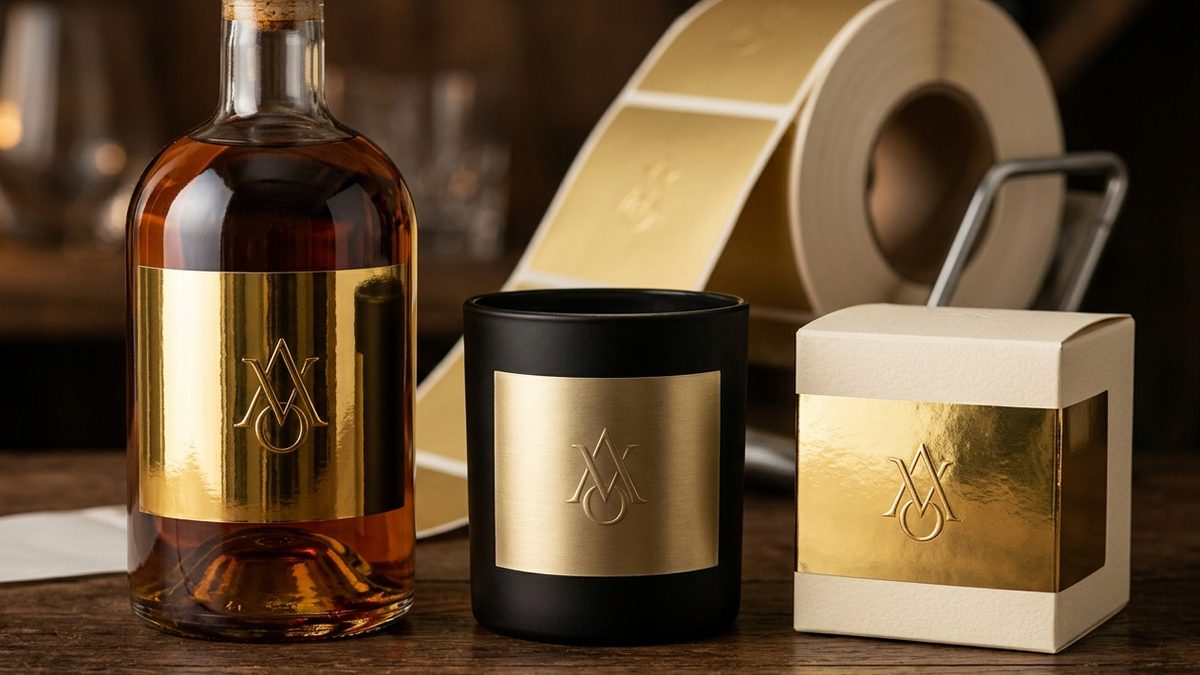
Gold is the shortest visual shorthand for "premium" that exists. On a crowded shelf a metallic label catches overhead light and moves as the shopper moves — something no flat colour can do. Traditionally that effect meant hot-foil stamping: a custom brass die, a set-up fee, and a minimum run. Gold roll labels get you the same shelf presence by printing directly onto a metallised gold face stock, so the whole label is gold from edge to edge and there is no die to pay for. Order 100 or 10,000, in any shape, and the price simply follows the quantity tiers.
How a gold label is actually made
The face stock is a paper or film base with a vacuum-metallised aluminium layer tinted to a warm gold tone. It arrives already gold. Your artwork is then printed on top in CMYK, with an optional white ink layer laid down first wherever you want colour to look like colour instead of a gold-tinted version of itself. Anything you leave unprinted stays mirror-gold. That single trick — deciding what gets white underprint and what doesn't — is the whole craft of designing for metallic stock.
Bright Gold vs. Dull Gold — which finish?
- Bright Gold (high-gloss): a mirror-like reflective surface. Maximum sparkle, reads as festive, celebratory, luxurious. Ideal for spirits, champagne, confectionery, holiday gifting, awards and event labels. Fingerprints and scuffs show more, so laminate if the product will be handled repeatedly.
- Dull Gold (satin/matte): a soft brushed-metal look. Reads as understated, heritage, artisanal. Ideal for craft whisky, olive oil, skincare, candles, coffee and anything positioned as quiet luxury. Hides fingerprints and photographs without hot-spots.
- Rule of thumb: if the brand shouts, go Bright. If the brand whispers, go Dull. Both take CMYK and white underprint identically.
White ink underprint — the most important checkbox on the order
Ink is translucent. Print cyan straight onto gold and you get a murky greenish-bronze, because the gold shows through. Print a white layer first and the cyan sits on white and looks like cyan. So the design decision is: where do you want true colour (white underprint) and where do you want gold showing through (no underprint)?
- Logo and product name in solid gold — leave them unprinted. The stock does the work.
- Photographs, brand colours, illustrations — put white underneath so they reproduce accurately.
- Black type directly on gold needs no white; it prints dense and crisp.
- Tinted overprints (no white, 20–60% of a colour) produce coloured-metal effects: a light magenta over gold reads as rose gold, cyan as antique bronze, yellow as brighter gold. Great for subtle patterns.
- Supply the white layer as a separate spot colour named "WHITE" set to overprint, or ask our pre-press team to build it — we do it free on every gold order.
Design rules for metallic stock
- Use negative space. The strongest gold labels are 40–60% unprinted gold. Fill the whole label with ink and you have bought a very expensive white label.
- Contrast is king. Deep navy, black, burgundy, forest green and cream all sit beautifully on gold. Mid-tone colours fight it.
- Fine serif type and thin line-art engrave well — the gold shows through the strokes. Keep hairlines above 0.25 pt.
- Avoid large flat areas of light colour on white underprint; they look like paper stuck on metal. Use them as small accents instead.
- Resolution: 300 DPI at final size, CMYK, PDF/X-4, 0.125" bleed, text 0.0625" inside the die line.
Lamination, spot UV and a second foil
Gold labels ship unlaminated by default so nothing sits between the eye and the metal. For products that get handled, shipped loose, or live in a bathroom, add a lamination:
- Gloss lamination — protects the surface and slightly amplifies Bright Gold's mirror effect.
- Matte lamination — turns Bright Gold into a softer satin finish (a popular way to get 'Dull Gold plus protection'), and adds scuff resistance.
- Soft-touch lamination — velvet hand-feel over gold. The fragrance-box tier; pairs beautifully with black type.
- Spot UV — glossy varnish only where you want it (a logo or a pattern) over a matte-laminated gold label produces a two-texture finish that photographs superbly.
- Second foil — yes, you can foil-stamp on top of gold stock. Silver, rose gold or holographic foil over dull gold creates a two-metal label that no flat printing can imitate.
Adhesives and application surfaces
- Permanent (standard): glass bottles, PET, rigid boxes, tins, coated cartons. Service range –4 °F to 158 °F.
- Aggressive: low-energy plastics (squeeze tubes, PP jars), textured surfaces, and cold-applied lines. Highest initial tack.
- Removable: gift tags, seasonal promotions, reusable containers, sampling — peels clean for months.
- Metallic stock is stiffer than paper, so on very tight curves (under 1" diameter) choose a narrower label or a film base. Tell us the container and we'll advise.
Where gold labels earn their keep
- Spirits, wine and craft beer: neck labels, medallions, limited-edition front labels, and 'batch no.' seals.
- Beauty and skincare: jar lids, tube fronts, serum bottles — dull gold with white type is the current premium look.
- Candles and home fragrance: circular lid labels and wrap-around jar labels.
- Confectionery and bakery: box seals, chocolate bar bands, macaron boxes.
- Coffee and tea: bag front panels and tin lids.
- Events and awards: wax-seal-style circles, wedding favour tags, corporate gift stickers.
Shapes, sizes, minimums and turnaround
Rectangles, squares, circles and ovals are standard, with square or rounded corners; custom die-cut shapes are available on request. Sizes run from tiny 0.5" seals to full wrap-around bottle labels. The minimum order is just 100 labels — versus 500–1,000 for most foil-stamped runs — and the unit price drops by more than 70% between 100 and 10,000 pieces. Standard production is 3–5 business days; labels are made in the USA in Houston, Texas and ship nationwide on rolls wound to your applicator spec.
- Silver Roll LabelsThe cool-tone metallic sibling
- Holographic Roll LabelsRainbow foil + anti-counterfeit
- White BOPP Synthetic Labels GuideFor wet, cold or handled products
- Roll Label Material GuidePaper vs. synthetic vs. metallic
Frequently asked questions
- Are these labels made in the USA?
- Yes. Every roll is printed, die-cut and finished in our Houston, Texas facility — made in the USA — and we ship nationwide to all 50 states with same-day dispatch on orders confirmed before 11 AM CT.
- Are gold roll labels the same as gold foil labels?
- They look the same on the shelf but are made differently. Foil stamping presses metallic foil onto a paper label with a heated die; gold roll labels are printed on a face stock that is already metallic gold. The printed version has no die cost, no set-up fee and a 100-label minimum.
- Can I print full colour on a gold label?
- Yes. We lay down a white ink underprint wherever you want accurate colour, then print CMYK on top. Areas without white show the gold through the ink for metallic-tinted effects.
- Bright Gold or Dull Gold — which should I choose?
- Bright Gold is mirror-like and festive; Dull Gold is a satin brushed-metal look that hides fingerprints and reads as quiet luxury. Spirits and gifting usually go Bright; skincare, candles and coffee usually go Dull.
- Will gold labels survive outdoors or in a fridge?
- The metallic stock is rated for indoor and outdoor use and the permanent adhesive holds down to –4 °F. For condensation, ice buckets or repeated handling, add gloss or matte lamination.
- Can I add foil stamping or spot UV on top of gold stock?
- Yes. Silver, rose gold and holographic foil stamps and spot UV varnish can all be applied over gold labels for a two-metal or two-texture finish.
- What is the minimum order and turnaround?
- 100 labels per design, with price breaks at 250, 500, 1,000, 2,500, 5,000 and 10,000. Standard production is 3–5 business days from proof approval.
- What file do you need?
- A print-ready PDF (PDF/X-4) in CMYK at 300 DPI with 0.125" bleed. Mark white underprint as a spot colour named WHITE, or let our pre-press team build it for you at no charge.
Kolt Printing ships from Houston, TX every business day.
Live pricing on every product. Free die templates. Same-day shipping cut-off at 11 AM Central. Trade pricing for agencies and print brokers.