UL Certified Roll Labels — What UL 969 Means and How to Order Compliant Labels
What UL 969 certification actually covers, why white PET is the substrate, how adhesive lot tracking works for audits, and which lamination to specify for heat, chemicals and outdoor exposure. The complete guide to UL certified roll labels for electrical equipment, machinery, appliances and OEM manufacturing.
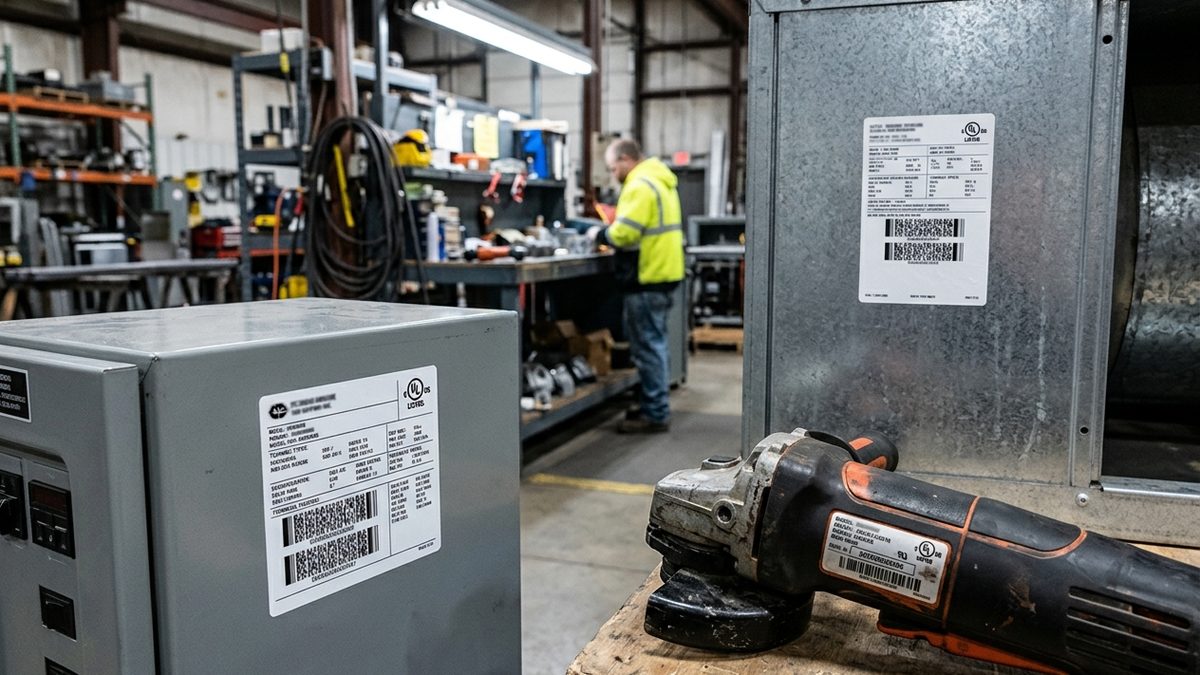
The label that has to survive the life of the product
A rating plate on an appliance, a warning label on a power tool, a serial plate inside a control panel — these labels are part of the product's safety certification. If they fade, peel or smear, the product can fail inspection and the manufacturer carries the liability. UL 969 is the Underwriters Laboratories standard for Marking and Labeling Systems, and our UL Certified Roll Labels are printed on a white polyester (PET) construction that has been tested and recognised under it, with adhesive lot data supplied for your compliance file.
What UL 969 actually certifies
UL 969 does not certify your artwork — it certifies the labelling system: the face stock, the adhesive, the printing method and the over-laminate, tested together against the surfaces and conditions the label will meet in service. Tests include adhesion after exposure to heat and humidity, abrasion resistance, legibility after chemical and solvent exposure, low-temperature performance and, where specified, outdoor weathering. When a system passes, it earns a UL Recognized Component Mark and a listing of the substrates (aluminium, stainless, painted steel, ABS, polycarbonate…) and temperature ranges it is approved for.
- Ask for the UL file number and the approved-surface list before you order — we supply both.
- The end product's UL inspector checks that the label system is listed for the surface and temperature it is applied to.
- Any change to the construction (different laminate, different adhesive) is a different system and needs its own recognition.
Why white PET
- Dimensional stability: polyester does not shrink, stretch or curl with heat, so barcodes and fine type stay legible for the life of the equipment.
- Heat resistance: continuous service to roughly 300 °F (150 °C) depending on laminate — well above motors, transformers and lighting housings.
- Chemical resistance: survives oils, coolants, cleaning solvents and fuels found in industrial and automotive settings.
- Bright white base: maximum contrast for black type, red warning panels and scannable barcodes.
- Tear-proof: cannot be picked off in strips — a requirement for tamper resistance on many products.
Adhesive choice and lot tracking
- Standard permanent acrylic: painted metal, aluminium, stainless, most rigid plastics. General-purpose for indoor equipment.
- Aggressive: low-surface-energy plastics (polyethylene, polypropylene, powder-coat with release agents) and textured castings.
- High-temperature: for labels applied near heat sources or on equipment that runs hot continuously.
- Every roll ships with the adhesive lot number recorded on the packing slip and the box label, so your quality team can trace a label back to its material batch during a UL follow-up inspection or a customer audit.
Choosing the over-laminate
- Gloss lamination: the standard indoor protective layer — abrasion and chemical resistance, wipe-clean.
- Matte lamination: same protection with reduced glare for labels read under bright factory lighting or photographed for documentation.
- UV-Resistant Gloss (1.6 mil): the outdoor specification — HVAC condensers, generators, solar and telecom enclosures, outdoor lighting. Slows UV fade of inks and extends outdoor life to years.
- Holographic lamination: adds a tamper-evident, anti-counterfeit shimmer over the printed data — used on warranty and authenticity plates for high-value equipment.
Designing a compliant label
- Follow the marking requirements in the product's own UL standard (voltage, amperage, frequency, model, serial, manufacturer, cautionary statements). We print what you supply; your NRTL confirms content.
- Use black text on white for primary data; reserve red, orange and yellow panels for hazard statements per ANSI Z535.
- Minimum type size 6 pt for rating data, 8 pt+ for warnings. Sans-serif faces survive abrasion best.
- Barcodes and QR codes: minimum 80% magnification with a quiet zone; we test-scan a proof on request.
- Variable data (serial numbers, dates, model variants) can be printed sequentially — send a CSV with your order.
- Supply CMYK PDF at 300 DPI, 0.0625" safe zone, with a DIELINE layer for custom shapes.
Typical applications
- Electrical panels, switchgear, transformers and control enclosures — rating and warning plates.
- Appliances, HVAC units, water heaters and pumps — nameplates and energy labels.
- Power tools, chargers, batteries and lighting — caution and certification marks.
- Industrial machinery and OEM sub-assemblies — serial, model and revision labels.
- Medical and laboratory equipment housings — durable identification and service labels.
- Telecom, solar and outdoor electronics enclosures — with UV-Resistant Gloss laminate.
Minimums and turnaround
Minimum order 100 labels with price breaks at 250, 500, 1,000, 2,500, 5,000 and 10,000. Rectangle, square, circle and oval shapes with square or rounded corners; custom die-cuts and sequential numbering available. Standard production 3–5 business days after proof approval; every roll is made in the USA in Houston, Texas and shipped nationwide with lot documentation and, on request, the UL file reference.
- Silver Roll Labels GuideBrushed PET nameplates for equipment
- Fluorescent Roll Labels GuideNeon warning and inventory labels
- Roll Label Material GuidePaper vs. synthetic vs. polyester
Frequently asked questions
- Are these labels made in the USA?
- Yes. Every roll is printed, die-cut and finished in our Houston, Texas facility — made in the USA — and we ship nationwide to all 50 states with same-day dispatch on orders confirmed before 11 AM CT.
- What does UL 969 certified mean for a label?
- The complete label system — polyester face stock, adhesive, print and laminate — has been tested by UL for adhesion, abrasion, chemical exposure and legibility on specified surfaces and temperature ranges, and carries a UL Recognized Component file.
- Does UL certification cover my artwork?
- No. UL 969 covers the label materials and construction. The content of the label (ratings, warnings) is governed by the end product's own UL standard and checked by your inspector.
- Can UL labels be used outdoors?
- Yes, with the UV-Resistant Gloss (1.6 mil) laminate, which is the outdoor-rated construction for HVAC, generator, solar and telecom equipment.
- How does adhesive lot tracking work?
- Every roll's adhesive lot number is recorded on the packing slip and box label, so your quality file can trace any installed label back to its material batch during audits.
- What surfaces are approved?
- Typical recognitions include aluminium, stainless and painted steel, ABS, polycarbonate and powder-coated metal. Ask us for the current approved-surface list for your file.
- Can you print serial numbers?
- Yes — sequential numbers, barcodes and QR codes are printed as variable data from your CSV.
- What is the minimum order?
- 100 labels per design, with tiered pricing to 10,000+.
Kolt Printing ships from Houston, TX every business day.
Live pricing on every product. Free die templates. Same-day shipping cut-off at 11 AM Central. Trade pricing for agencies and print brokers.